Bazzy's Domain! (Guest)Tuesday 27-October-2026 12:33:56Home
(Guest)Tuesday 27-October-2026 12:33:56Home(Guest)Tuesday 27-October-2026 12:33:56Home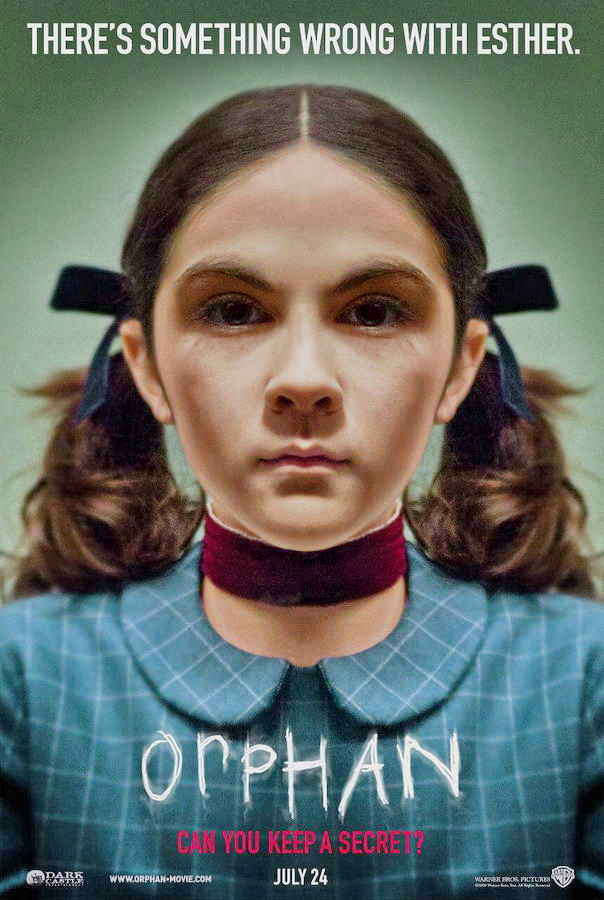
Orphan is a 2009 American psychological horror film directed by Jaume Collet-Serra and starring Vera Farmiga, Peter Sarsgaard, and Isabelle Fuhrman. The film centers on a couple who, after the death of their unborn child, adopt a mysterious nine-year old girl.
Orphan was produced by Joel Silver and Susan Downey of Dark Castle Entertainment and Leonardo DiCaprio and Jennifer Davisson Killoran of Appian Way Productions and was released theatrically in the United States on July 24, 2009.
The film received mixed critical reviews although Fuhrman's performance as Esther was acclaimed.
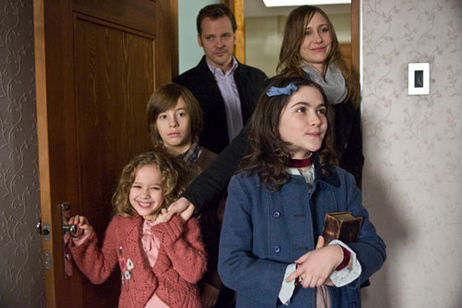 Esther and the Colemans
 JupiterJupiter is the fifth planet from the Sun and the largest in the Solar System. It is a gas giant with a mass one-thousandth that of the Sun, but two-and-a-half times that of all the other planets in the Solar System combined. Jupiter is one of the brightest objects visible to the naked eye in the night sky, and has been known to ancient civilizations since before recorded history. It is named after the Roman god Jupiter.[19] When viewed from Earth, Jupiter can be bright enough for its reflected light to cast visible shadows,[20] and is on average the third-brightest natural object in the night sky after the Moon and Venus.

Russian Doll is an American comedy-drama television series, created by Natasha Lyonne, Leslye Headland, and Amy Poehler, that premiered on Netflix on February 1, 2019. The series follows Nadia Vulvokov (Lyonne), a game developer who repeatedly dies and relives the same night in an ongoing time loop and tries to solve it, leading to her finding Alan Zaveri (Charlie Barnett) in the same situation. It also stars Greta Lee, Yul Vazquez, Elizabeth Ashley, and Chloë Sevigny. Nadia - The Russian Doll
Its first season received four Primetime Emmy Award nominations, including Outstanding Comedy Series and Outstanding Lead Actress in a Comedy Series for Lyonne. In June 2019, the series was renewed for a second season, which premiered on April 20, 2022.
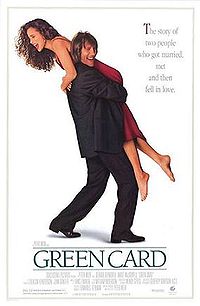 Green Card is a 1990 American/Australian/French romantic comedy film written, produced, and directed by Peter Weir. The screenplay focuses on an American woman who enters into a marriage of convenience with a Frenchman so he can obtain a green card and remain in the United States.
Brontë Mitchell is a horticulturalist and an environmentalist devoted to the creation of urban gardens and parks on vacant lots. She is anxious to rent an apartment with a greenhouse, but the board of trustees would prefer a married couple as tenants. Her friend Antoine suggests she marry French immigrant Georges Fauré, who needs a green card in order to remain in the country. The two meet at a cafe in downtown Manhattan and after a brief conversation are wed in a quick ceremony at the nearby courthouse.
As a married woman, Brontë qualifies for the apartment of her dreams and, after moving in, she tells the doorman and neighbors her spouse is doing musical research in Africa. When she is contacted by the Immigration and Naturalization Service to arrange an interview to determine her marriage is legitimate, she tracks down Georges, who is working as a waiter. Although the two have little time to get their facts straight, the agents who question them appear to be satisfied with their answers.  Georges and Brontë It's only when one of them asks to use the bathroom and Georges directs him to a closet that their suspicions are aroused, and they schedule a full and formal interview to be conducted two weeks later at their office.
Brontë consults an attorney, who advises her she could be charged with a crime if the authorities learn the truth about her marriage. She invites Georges to move in with her to enable them to learn about each other's past and their quirks and habits, and they quickly learn they can barely tolerate each other. Georges is a gregarious slob and heavy smoker who prefers red meat to healthy food, while Brontë is a strait-laced clean freak obsessed with her plants. When her parents arrive at the apartment for an unannounced visit, Georges pretends to be the handyman.